
9 Hidden Costs of Building a Website Most Agencies Don't Mention
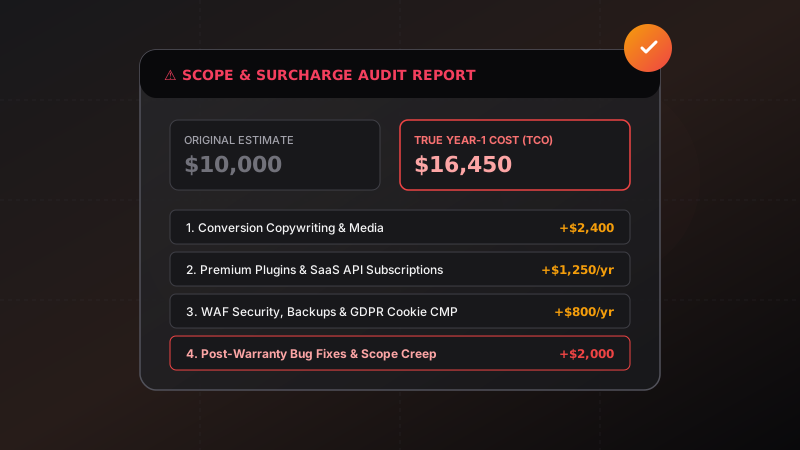
You’ve negotiated a web agency proposal down to $12,000, signed the contract, and toasted to your upcoming project launch. Then, six weeks into development, the surprise invoices start trickling in: "Copywriting surcharge: $1,500," "Plugin subscription tier upgrade: $499/yr," "Font licensing: $350."
According to recent digital procurement studies, nearly 64% of web design projects exceed their initial quoted budget. This occurs not because agencies are necessarily malicious, but because clients frequently confuse development labor with the complete ecosystem of software and operational assets required to run a modern website.
Before signing any web proposal, test your assumptions in our Comprehensive Website Cost Estimator to check itemized line items across development, content, and maintenance.
1. Professional Content Copywriting & Asset Creation
The #1 cause of project delays and budget blowouts is content. Many first-time buyers assume that an agency will automatically write all page copy, create custom graphics, and shoot photography. In reality, most agency proposals contain the clause: "Client to supply all written text and high-res media."
If you cannot write persuasive, SEO-optimized copy internally, hiring a professional B2B conversion copywriter costs between $150 and $400 per page. For a standard 12-page business site, that adds $1,800 – $4,800 to your bottom line. Check our baseline pricing in the 2026 Website Cost Blueprint.
2. Premium CMS Plugins & Theme Subscriptions
If your site is built on WordPress, WooCommerce, or Shopify, your developer will inevitably leverage commercial extensions for custom forms, caching, security firewalls, and dynamic filters.
- Advanced Custom Fields (ACF Pro): ~$49 – $249/yr
- Gravity Forms / WPForms Elite: ~$199 – $299/yr
- WP Rocket / Speed Caching: ~$59 – $299/yr
- Shopify App Stack (Upsells, Reviews, Subscriptions): ~$100 – $450/month
These are recurring annual software expenses billed directly to your company card, often totaling $600 – $2,500/year.
3. Commercial Font & Stock Media Licensing
Did your UI designer choose a gorgeous custom typeface from Adobe Fonts, Linotype, or Monotype? Web fonts are licensed based on monthly pageview tiers according to Mozilla MDN Web Font Guidelines. Premium font web licenses range from $50 to $800/year. Add stock photography packages (iStock, Shutterstock) at $200 – $600, and you have another immediate budget delta.
4. Payment Gateway & Merchant Transaction Fees
Building checkout functionality with Stripe, PayPal, or Adyen requires more than just API coding. Credit card processors take 2.9% + $0.30 per transaction on domestic cards, and up to 3.9% for international currencies. For an e-commerce store processing $50,000/month, that represents $17,400+ annually in gateway cuts. Learn more in our E-Commerce Cost Guide.
5. Enterprise Security, SSL & Automated Cloud Backups
While basic Let's Encrypt SSL certificates are free, mission-critical business websites require Web Application Firewalls (Cloudflare Enterprise, Sucuri, Wordfence Premium) and real-time off-site backup storage (Amazon S3 / Google Cloud Storage).
Expect to invest $30 – $150/month in security monitoring to protect customer records and comply with PCI Security Standards.
6. Third-Party API Usage Tiers
Modern websites rely heavily on external microservices:
- Google Maps API: Pay-per-load geocoding and map rendering after free credits expire.
- Transactional Email (SendGrid, Postmark, Mailgun): $15 – $90/month for password resets, order receipts, and form lead routing.
- Algolia / Custom Site Search: $50 – $300/month for instant autocomplete search indexing.
7. Privacy & Cookie Compliance Software (GDPR / CCPA)
If your website receives traffic from Europe or California, you are legally required to provide compliant cookie consent management platforms (CMP) like Cookiebot, OneTrust, or Termly. These compliance platforms charge $15 – $60/month per domain. Review our own compliant structure on our Cookie Policy Page.
8. Post-Launch Bug Fixes & Scope Creep Retainers
Most fixed-price agency contracts include only 14 to 30 days of post-launch warranty support. Once that period ends, minor tweaks—such as changing team bios, updating pricing tables, or altering lead form fields—are billed at agency standard hourly rates ($125 – $225/hour).
Subscribing to a monthly support retainer is significantly more economical than ad-hoc emergency billing. Review typical monthly tiers in our Website Maintenance Retainer Guide.
9. CRM & Marketing Automation Sync Engineering
Wiring website lead forms to automatically populate contacts into HubSpot, Salesforce, or Klaviyo with custom attribution tracking (UTM parameters, source tagging) frequently requires 10–20 hours of specialized middleware or Zapier/Make automation logic, adding $1,000 – $3,000 in integration fees.
How to Protect Your Budget: The 5-Point RFP Checklist
- Demand an "All-In" Software Bill of Materials (SBOM): Ask the vendor to itemize every recurring plugin, API, and server license required.
- Clarify Content Roles in Writing: Define who is writing copy, sourcing images, and entering product data.
- Establish Post-Launch Warranty Terms: Secure a minimum 60-day bug warranty in the master services agreement (MSA).
- Review Tech Stack Suitability: Read our comparison on Custom Code vs. WordPress vs. Shopify to ensure your stack minimizes plugin bloat.
- Use Benchmarked Quotes: Leverage our Website Cost Calculator to cross-examine contractor estimates.